
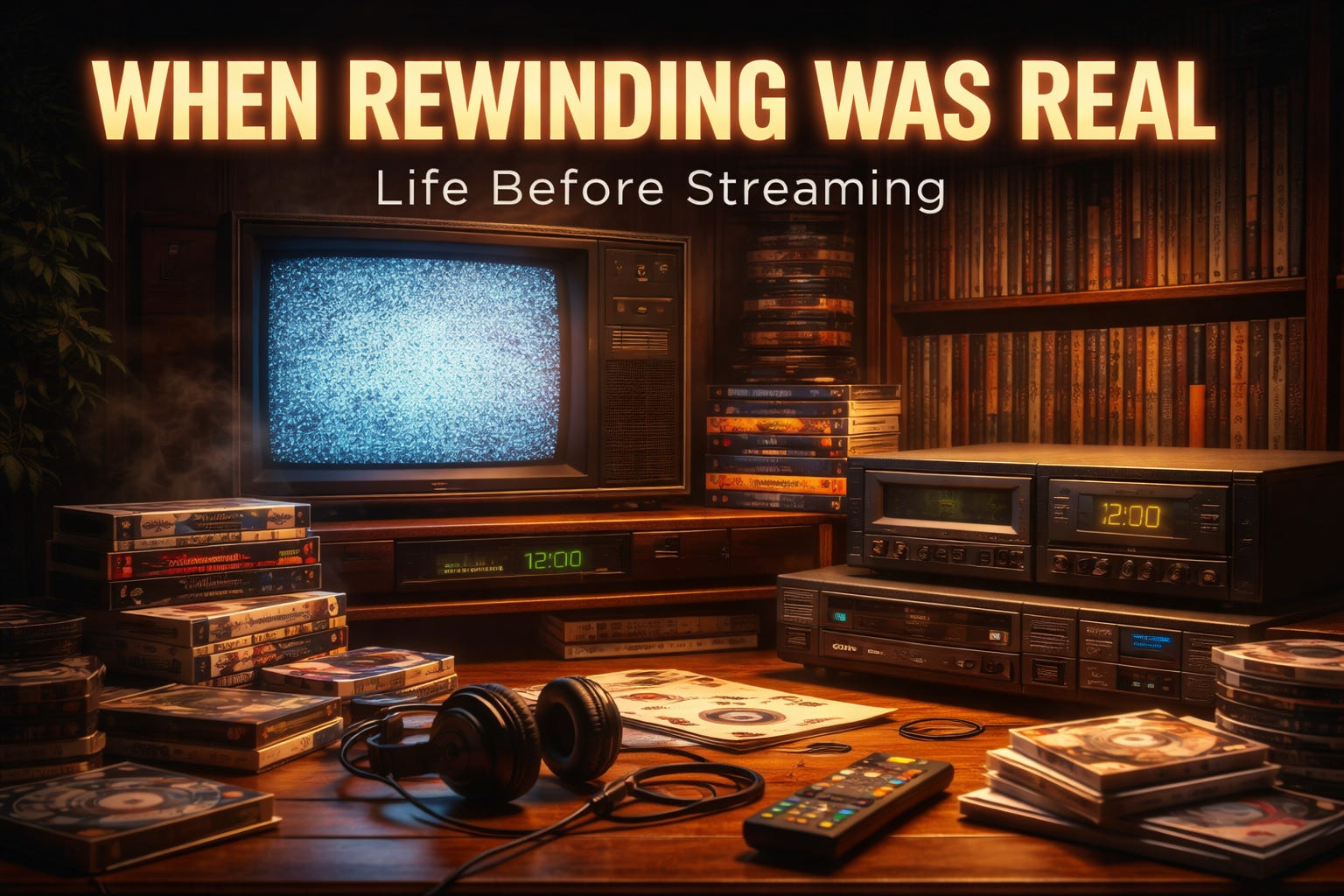
Throwback: When Rewinding Was Real
Life Before Streaming

Author’s Note: The following article was first published May 5th, 2025 on Medium.com
Growing up in the mid-’80s and early ’90s, there were pieces of technology I remember seeing but never really using. Eight-track players and record players were common fixtures in my grandfather’s house, and my dad kept a few of them in our basement.
I remember tinkering with an old record player down there, never quite figuring out how it worked. My dad’s radio setup — which he still owns — had two cassette decks and a slot for 8-tracks. But we never had any 8-tracks, so I never saw one actually used.
Now, as my son turned 17 in February and my daughter turns 15 in May, I’ve been thinking about all the technology they’ve seen sitting around our house but never touched — tech that was everywhere in my childhood and is completely obsolete in theirs.
Cassette Tapes, VHS Tapes and Tape Players
My childhood was framed around tape — cassette tapes, VHS tapes, even old projectors with film reels in my earliest years. Tape handled everything: audio, video, memory. And the machines to play it were everywhere.
For audio, we had cassette tapes. Most stereos had one or two “decks.” Both could play music, but usually one could record whatever the other was playing. With that feature, you could duplicate albums or build custom mashups — what we called mix tapes.
For video, we had VHS tapes and VCRs. If you wanted to watch a movie, you either waited for it to air on TV or rented it from Blockbuster or Hollywood Video. If you didn’t want to buy it, you recorded it off television. Our bookshelf was lined with labeled VHS recordings of movies and races and random TV specials.
My grandmother used to record NASCAR races for me in case I missed them. And remember — there was no internet for highlights or recaps. If you didn’t record it, you didn’t see it.
Rewinding wasn’t optional. It was part of the experience.
CDs, & DVDs and their Players (Disc-man)
I lived through the rise — and fall — of the compact disc (CD) and the digital versatile disc (DVD).
When CDs took off, it felt immediate and explosive. Columbia House was infamous for offering 8 or 10 CDs for almost nothing. The catch, of course, was the automatic shipments that followed.
Still, when the offers shifted from tapes to CDs, it felt like a leap into the future.
One of my favorite memories is when my dad bought a 100-disc CD player.
It functioned like a jukebox. You punched in a number, and a small internal elevator would retrieve the disc, load it, and start playing. As a teenager who had grown up rewinding tapes just to replay a single song, this felt revolutionary.
Imagine — all your music available at the push of a button.
Surely this was the peak of technology.
Then DVDs arrived. Their adoption was so fast it’s hard to remember the transition clearly. Floppy disks and tapes faded almost overnight. Computers came with CD/DVD burners, and suddenly you could store everything — music, movies, documents, games — on shiny little discs.
It felt permanent. Rewritable. Future-proof.
It wasn’t.
Corded Phones, Cordless Phones, and Dumb-Cell Phones
A corded phone hanging in the kitchen was standard. I remember when we bought an extra-long cord so you didn’t have to stand in one place while talking. That felt like freedom.
Around the same time, cordless phones hit the market — but they were expensive. Dad and I went to Radio Shack to look at them. We left with a longer cord instead.
Eventually, cordless phones became affordable, and homes replaced wall-mounted phones with charging bases and portable handsets.
Cell phones, at first, were a luxury. By the time I went to college, they were emerging but not universal. My freshman year, I used prepaid calling cards to call home. By sophomore year, it was cheaper to get a cell phone and wait until 9 p.m. — when “unlimited nights” kicked in.
These weren’t smartphones. They were dumb phones. Calls and texts only. No touchscreens. No apps. No full keyboard — just the 0–9 keypad with three letters per button.
I remember connecting my cell phone to my computer with a USB cable and dialing into my parents’ internet after 9 p.m. for free. That felt like hacking the system.
Surely, we thought, technology had peaked.
What Kids Today Will Never Miss
Each of these technologies solved a specific problem. Audio. Video. Communication. Data storage. Photography. Gaming.
Separately, they were becoming the best versions of themselves.
At the same time — almost invisibly — they were merging.
As someone born in the ’80s, I got to witness full technological life cycles. I saw things become essential… and then disappear.
That’s why our generation appreciates today’s convenience. We remember rewinding tapes. Flipping through CD binders. Waiting for downloads. Recording races so we wouldn’t miss them.
Kids today don’t need to appreciate those technologies.
And that’s okay.
I never jammed to 8-tracks in my car. I don’t expect my kids to dust off a 100-disc CD player when they have Spotify in their pockets.
But there was something about that tension.
The waiting.
The physical act of pressing rewind and hearing the whir.
It was conveniently inconvenient. Perfectly imperfect. Slower.
And somehow… more tangible.
It was a time when media had weight. When access required effort. When rewinding wasn’t a button — it was a sound.
It was a time that was… Uncredible.
Music for voice over by Jeremusic70 on Pixabay.