
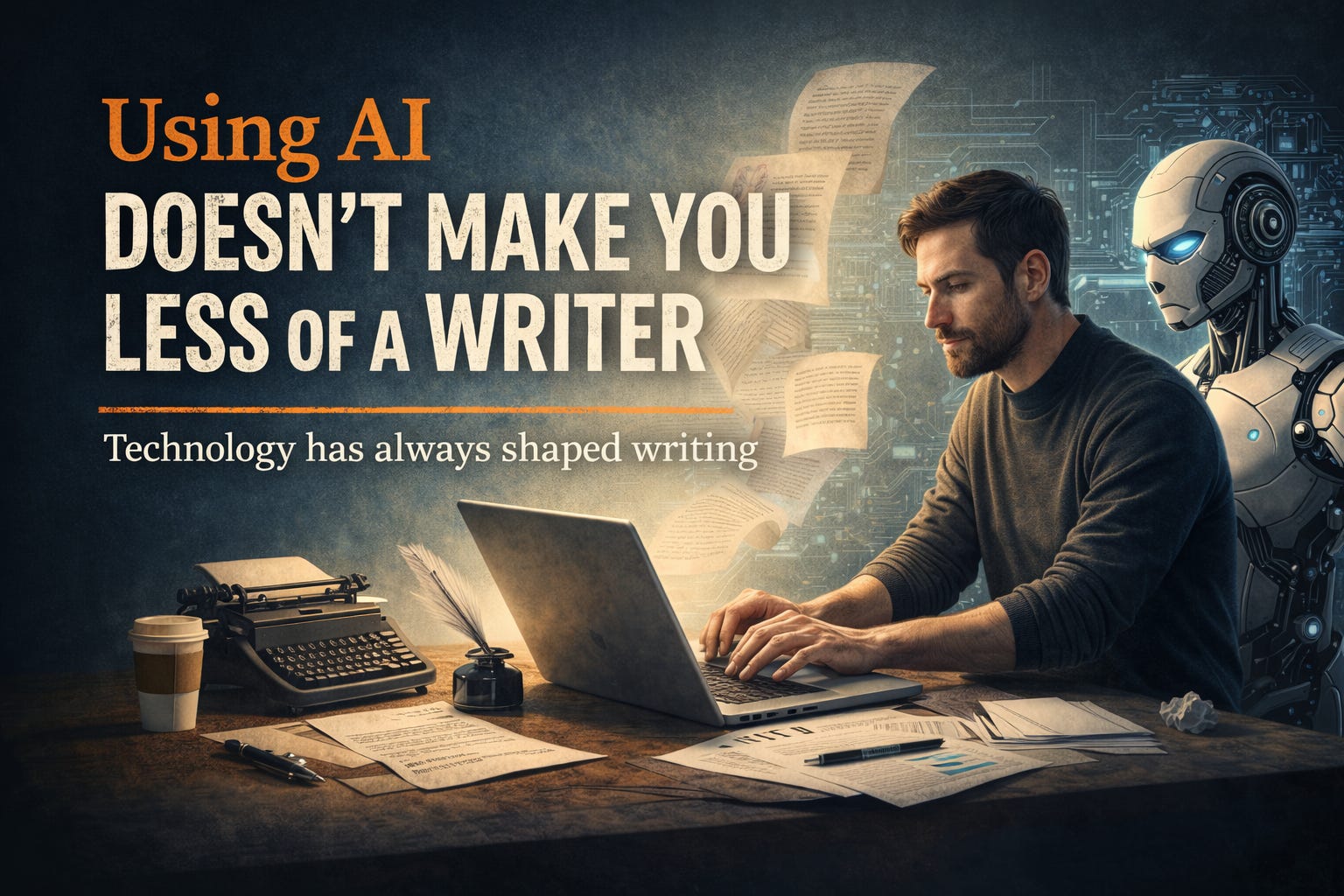
Throwback: Using AI Doesn’t Make You Less of a Writer
Technology has always shaped writing

The following article was first published on June 6th, 2025 on Medium.com
I’ve been reading a lot of articles recently that argue against the use of AI in writing. One that stood out — and has since been deleted — explained why the author doesn’t use AI, and why you shouldn’t either.
I understand where the author was coming from, but I think there’s a baby getting thrown out with the proverbial bathwater.
The entire AI conversation can be confusing, so I want to start by saying what I do agree with.
I agree that telling ChatGPT to write an SEO-optimized article designed to generate clicks and revenue about a trending topic falls outside what most people would consider “writing.”
It should go without saying that a writer writes.
Obviously, AI is blurring that distinction, as swindlers — not writers — pass off fully AI-generated content to chase clicks and revenue. However, I think articles condemning the use of AI for writers who need assistance — not with creativity, but with execution — are stifling creativity and gatekeeping the space.
Technology Is Supposed to Help
Technology exists to make things easier.
It removes tedious steps so creators can spend more time on the creative aspects of their work. Getting bogged down in the mechanics of turning thoughts into words can stunt a writer’s creativity.
Take animation, for example.
Remember when animators had to draw every single frame by hand? It was painstaking and time-consuming. Today, technology — and now AI — has eliminated much of that burden, allowing artists to focus on storytelling and design.
Would anyone argue that modern animation isn’t “real animation” because it’s not hand-drawn frame by frame?
Of course not.
Would you say doing it the old way is more authentic or somehow better for the artist?
No — you’d say it’s inefficient given modern tools.
Writing Technology Changed Too — We Just Forgot
Now apply that same logic to writing.
Do I need to bring up the printing press? Probably not.
No one is arguing that a “real writer” must handwrite every copy with an inkwell and feather pen. How a piece is distributed is different from how it’s created — but distribution has always influenced the writing process.
Have you ever been mid-sentence, searching for a better word?
You’ve already used the same word twice, and now you need something more precise.
Do you:
Put on wooden shoes
Saddle your horse
Ride to the nearest library
Flip through a card catalog
Find a thesaurus
No.
You Google it.
So why is that acceptable, but asking AI to assist with phrasing across an entire article somehow crosses a line?
Let’s Be Honest
Everyone reading this is typing on a computer.
That computer is:
Spell-checking
Grammar-checking
Flagging mistakes in real time
You see red lines. Green lines. Suggestions.
Is that allowed?
If so, I don’t see why using AI at a larger scale is suddenly unacceptable.
If we go back far enough, we’ll find a cranky English teacher scolding us for not using a feather pen.
We’ve moved on.
And writing is better for it.
Crushing Creativity For The Sake of The Old Way
This debate takes me back to sixth grade.
My English teacher, Mrs. Christian.
I was asked to write something on the board. I jumped up and did it — perfectly, as far as I could tell.
She looked horrified.
“Is that how you write your m’s?” she asked, half-laughing.
I checked my work. Nothing seemed wrong.
“Yes… what’s wrong with it?”
“Oh, dear,” she said, “you forgot the tail. Didn’t anyone teach you your ‘m’s’ should start with a tail?”
I sat down, embarrassed.
“No… that’s just how I write them.”
She smirked.
“Well, when you publish your own book, you can write however you want. Until then, use the tail.”
I did publish my own book.
Not because of her — but in spite of her.
And now?
I write my m’s however I want… on the rare occasion I handwrite anything at all.
The Notecard Era
Let me give you one more example.
My freshman literature professor insisted we write research papers using notecards.
Every quote. Every reference.
Each card required:
Full bibliographical information
A single quote or reference
Even if the source repeated — you rewrote it every time.
Tedious?
That’s putting it lightly.
But to be fair — I understood the system.
At the end, you could physically organize your argument. Sources were easy to track. Citations were clean.
For someone using a typewriter, it was brilliant.
But this was 2002.
We all had computers.
So I adapted.
Instead of notecards, I created a document. I organized sources digitally. I built my paper more efficiently.
Same principle.
Better execution.
Had she embraced that shift, she might have developed better researchers — not just better note-takers.
The Real Problem
These teachers weren’t wrong.
They were outdated.
And instead of adapting, they enforced their way — crushing creativity in the process.
Some students stopped writing altogether.
Not because they lacked ability…
But because the system punished efficiency and innovation.
I didn’t stop.
But not everyone has that kind of stubbornness.
Let AI Be the Assistant, Not the Author
Writers shouldn’t outsource creativity.
They shouldn’t pass off AI-generated work as their own.
But using AI to:
Refine writing
Improve structure
Speed up editing
That’s not cheating.
That’s evolution.
If you disagree, ask yourself:
Why are you typing instead of using a typewriter?
Why a ballpoint pen instead of an inkwell?
Why not chisels and stone?
Let’s stop pretending progress is the problem.
Let’s make room for writers who want to create better — not slower.
Let AI assist.
Not replace.
When we do that, we become — Uncredible.
Music for voice over by Jeremusic70 on Pixabay.