
Throwback: Death by Overwork
Effort Without Purpose Destroys Us

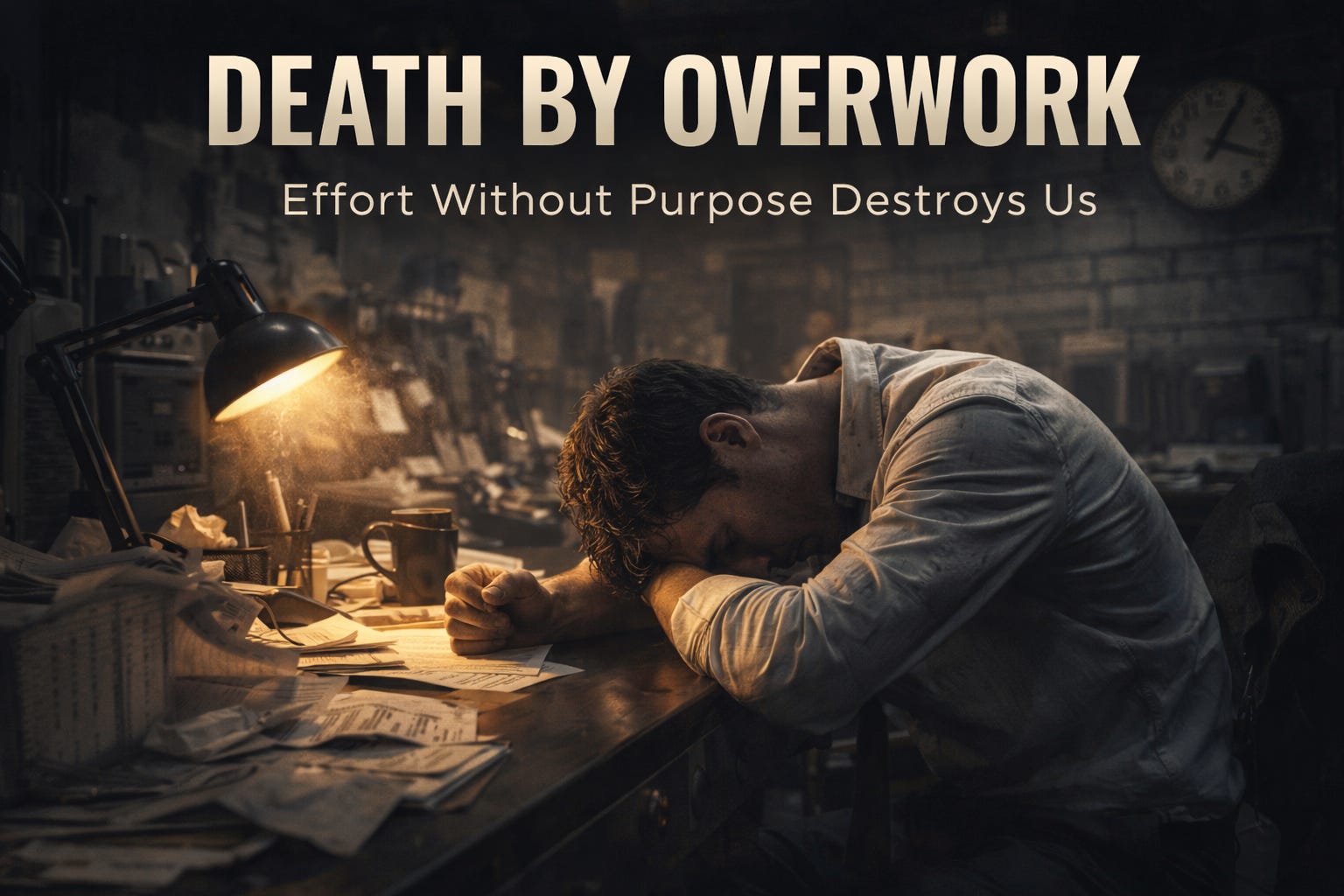
Author’s Note: This article originally published on May 7th, 2025 on Medium.com
Karoshi — What is it?
I discovered the Japanese concept of karoshi (過労死) a few years ago when I found myself working 60+ hours a week for multiple years. I remember telling my wife,
“I feel like I’m working myself to death.”
One evening, during a long night shift, I decided to look up words that literally meant work to death. To my surprise, I found countless articles about karoshi—a term used in Japan since the 1960s to describe sudden workplace deaths.
Two forms of death were especially prominent.
The first was physical exhaustion caused by consistently excessive work hours—people quite literally dropping dead from overwork. The leading cause was heart failure, often affecting people between the ages of 30 and 50. These individuals were working themselves to death in the most literal sense: karoshi.
The second was suicide (karojisatsu — 過労自殺), driven by extreme mental stress tied to overwork. Long nights, unrealistic expectations, and the emotional toll of layoffs affected workers at every level of organizations. The result was a documented rise in suicides directly linked to workplace pressure.
It left me wondering:
How could such a grim concept ever become motivating—or even positive?
A Guiding and Motivating Principle?
As I sat with the idea, I realized that karoshi’s darkness wasn’t rooted in hard work itself, but in why people were working themselves into the ground.
The problem wasn’t effort.
It was effort without purpose.
Society often glorifies hard work. We admire Olympians, CEOs, soldiers, and ultramarathoners. We consume their biographies, listen to their podcasts, and quote them endlessly on social media.
So what’s the difference between the ultramarathoner we admire and the exhausted employee we pity?
It’s not what they’re doing—it’s why.
The runner chooses the grind.
The overworked employee often doesn’t.
A job is usually a necessity, not a passion. That realization led me to a different question:
How do you take what you have to do and turn it into something you want to do?
Learn to Love What Others Hate.
Over the years, I’ve worked a lot of jobs, and one pattern stood out immediately:
Almost everyone hates night shifts.
Almost everyone clings tightly to the 40-hour workweek.
But I realized something different.
Working nights paid a shift premium.
Working 60 hours a week meant earning roughly 60% more—while still having two days off. In practice, I was making nearly as much as people working seven days a week.
Where others saw a burden, I saw an opportunity.
My job runs in cycles. Some months require 60+ hour weeks. Other times, we’re scraping to reach 40. But regardless of the cycle, people complained—too many hours, not enough family time; too little work, not enough pay.
It was all a matter of perspective.
Words like mandatory and required breed resentment. We hate being forced.
So I made a conscious decision:
I learned to love what others hated.
In college, if a professor required a 20-page paper with three sources, I turned in 40 pages with ten. If overtime was required, I volunteered for more.
I embraced it so fully that eventually the people assigning the work would ask me to slow down—and then I’d push just a little harder.
I’ll work until the people trying to force me start asking me to stop.
So… How Do You Do That?
How do you turn something you hate into something you love?
Simple—but not easy.
Stop focusing on the pain. Focus on the payoff.
If you’re working extra hours, focus on the money.
If your hours are cut, focus on the free time—use it to learn, rest, or grow.
When you choose what’s required, you’re no longer being forced. You take ownership. The task becomes a tool for your growth, not just someone else’s benefit.
There’s even timeless wisdom that echoes this idea:
“If anyone forces you to go one mile, go with him two.”
— Matthew 5:41
That’s how I reframed karoshi—from a defeated
“I’m working myself to death”
to a motivated
“I’m working myself to death!”
If I’m asked to go one mile, I’m running a marathon.
If there’s mandatory overtime, I’m volunteering for extra hours.
If there’s no overtime? I’m turning my phone off and taking a vacation.
It’s a shame to live at the mercy of someone else’s demands.
When you live on your own terms—even while doing what others hate—that’s… Uncredible.
Music for voice over by Jeremusic70 on Pixabay.