
Thriving in the Cold
Second Half Marathon Successes and Failures

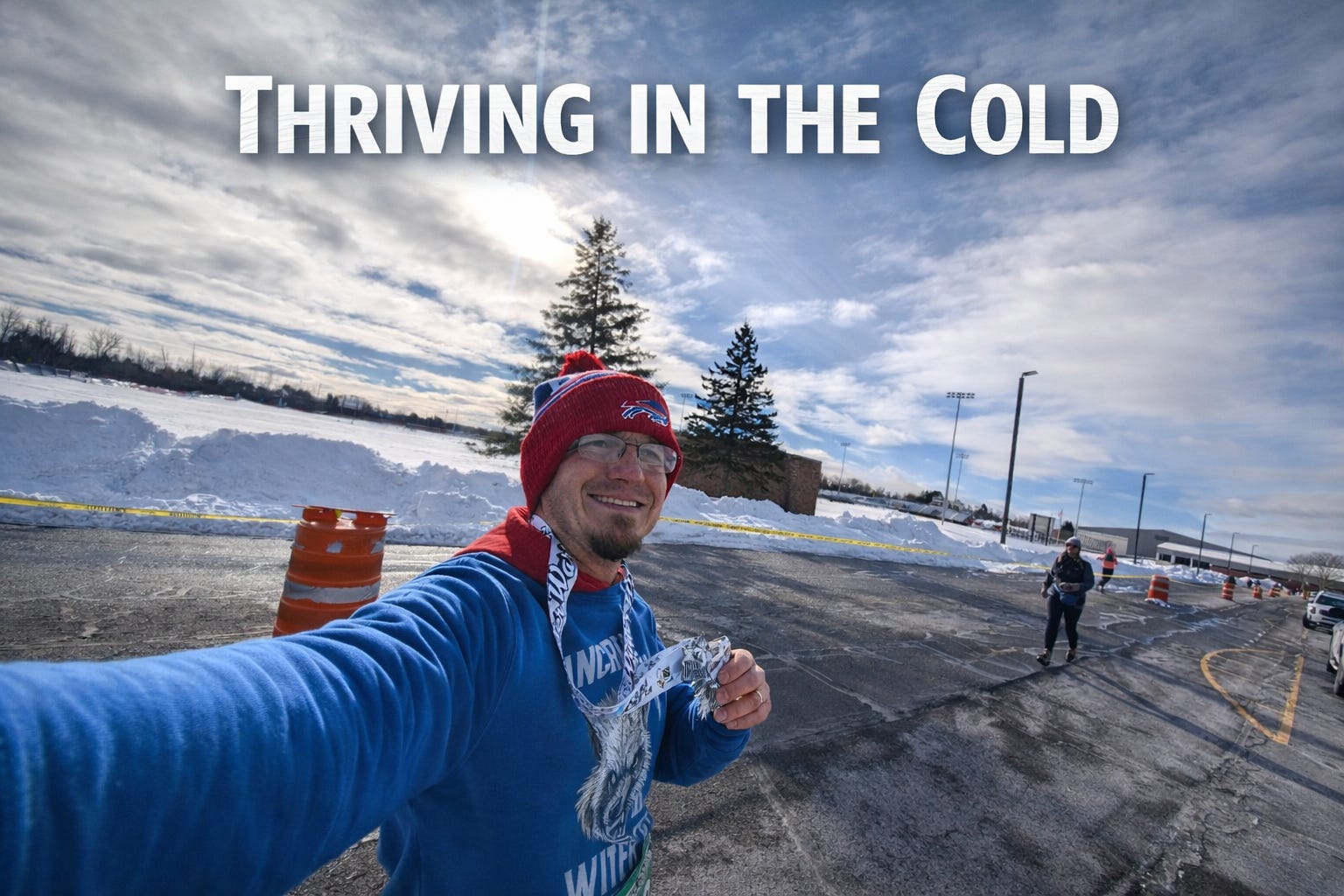
Last week, I reshared the five lessons I learned from my first half marathon. That article was called Surviving My First Half Marathon. When I reread it, I realized exactly why I chose that title.
Before that race, I had only ever competed in one other event—a local 5K I ran on a whim. I caught the “running bug” and immediately (foolishly?) signed myself up for a half marathon.
I burst out of the gate far too fast, ran through the dirt on the side of the road to pass other runners, and essentially gassed myself by miles 10 and 11. I remember how miserable I felt at the finish and how uncertain I was afterward about ever running a marathon. For months, I nursed IT band pain with a knee sleeve and brace I picked up at Walmart.
In a very real sense, that race was about survival.
Thriving in the Cold
For my second half marathon, I think it’s fair to say I thrived.
I beat my first half marathon chip time by a respectable 6 minutes and 25 seconds. I hit a personal milestone by finishing under two hours, with a time of 1:59:26. Just as importantly, I proved to myself that I’m not dependent on ideal conditions.
The month leading up to this race, I trained in snow, ice, and bitter cold—half-jokingly calling myself a Winter Beast.
Was that true, or was I all talk?
This race answered that question. Temperatures hovered around 22°F (-5°C)—legitimately sub-zero conditions. There were plenty of excuses available, but I didn’t take them. I delivered on every goal except one: a 1:50:00 finish.
Despite missing that aggressive target, the race was an undeniable success.
The course consisted of four loops of 3.275 miles around Monroe Community College. Each loop brought its own challenges.
Loop One—Pace Yourself
Pacing at the start of races is still something I’m working on. I did better this time—but I still went out too fast.
Right after the start/finish line, we climbed a slight grade before things leveled out. I remember thinking I’d push the hill and coast afterward.
I did not coast.
As we rounded the first corner, I noticed I was still running shoulder-to-shoulder with other runners. There’s something primal about racing—about wanting to compete. About three-quarters of a mile in, I thought, Surely that was a mile. I’m already tired.
That was my cue to slow down.
“Remember,” I told myself, “you’re conserving energy. Think 8:45–9:00 pace.”
I eased up and began settling in.
BUZZ.
Mile 1: 8:21
Too fast—but at least I was aware of it and adjusting.
Loop Two—Intrusive Thoughts
I tried to rein things in, but I continued at roughly the same pace through the rest of lap one:
Mile 2: 8:39
Mile 3: 8:29
Crossing the start/finish line to begin lap two, I knew I was making good time—but I also knew I couldn’t sustain this pace for three more laps.
Part of me wanted to slow down and log some comfortable 9:00 miles. The other part caught a hint of runner’s high—and I went with it.
This was the most enjoyable stretch of the race. My body warmed up, the wind died down, and everything felt controlled.
Mile 4: 8:33
Mile 5: 8:56
Midway through mile six, my energy began to dip. It was time to fuel. In training, I had walked during fueling, but I knew if I kept moving I could save a minute or two.
Still, my legs were starting to feel it.
“Slow down. Pace yourself,” one voice said.
“If you slow down now, you’ll never hit 1:50,” another argued.
“But if you don’t ease up, you’ll blow up later,” I countered.
Mile 6: 9:07
Loop Three — The Struggle Is Real
I returned to my original strategy: high-8s, low-9s early, then gradually pick it up.
That plan was already gone.
At this point, the goal became survival with intention. I decided to slow into the low-9s, recover slightly, and save enough to finish strong.
Instead, I faded more than planned.
Mile 7: 8:53
Mile 8: 9:21
Mile 9: 9:27
This wasn’t strategic anymore. My muscles tightened, and fatigue set in. Still, I reminded myself: I hadn’t walked. That mattered.
Mile 10: 9:13
As I hit the long straightaway before the final loop, my watch buzzed. The RaceJoy app projected a finish under two hours.
It wasn’t 1:50—but it was a milestone.
I slowed slightly, took a drink, and focused on my breathing. I let my heart rate settle and gave my legs the smallest chance to recover.
It was time to push—but not recklessly.
Loop Four — The Final Stretch
As I entered the final loop, I told myself: Just hold 9:30–10:00 pace and you’ve got this.
Around me, runners were breaking. Some walked. Some shuffled. Some alternated between jogging and walking.
I was fading—but I was still running.
Mile 11: 9:27
When mile 12 clicked off at 10:17, I started doing mental math. I knew my watch was about 30 seconds fast. By my calculation, I had a cushion.
I even considered walking briefly.
Instead, I remembered: this race was training for the Buffalo Marathon. At this stage of that race, I’ll need to find an easy rhythm and ride it.
So I did.
Mile 13: 9:58
Turning the final corner, I saw the clock.
1:59:15
My heart jumped—and sank.
I had no idea I was that close. I expected 1:58, maybe even 1:57.
I emptied the tank and crossed the line with a gun time of 1:59:33 and a chip time of 1:59:26.
A personal record.
A sub-two-hour half marathon.
In the dead of winter in Rochester, New York.
Mission accomplished.
Side by Side Comparison
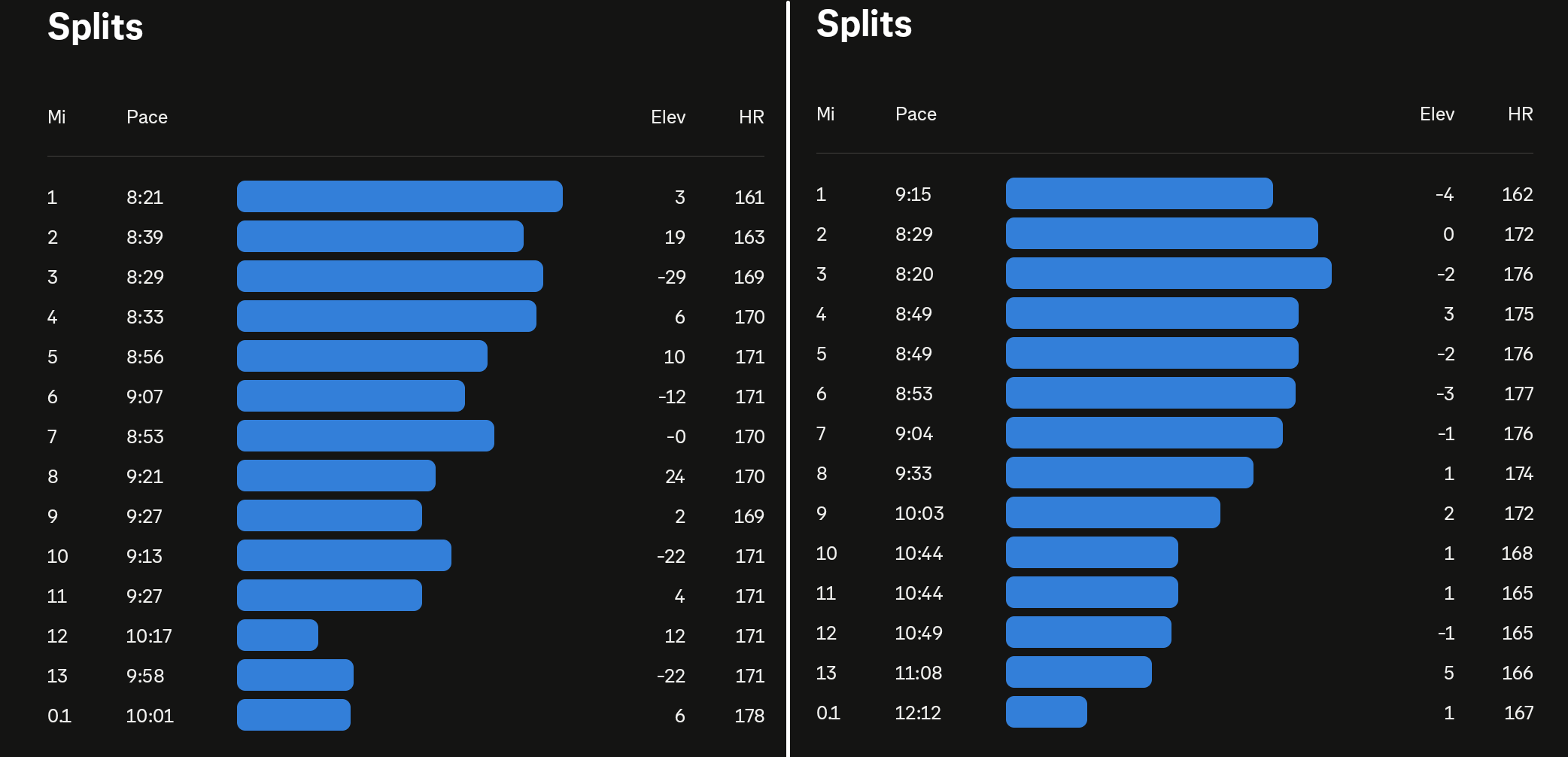
In both races, I was fairly consistent through the first seven miles, running between 8:30 and 9:10 pace. Notably, my heart rate during my first half marathon was 5–10 BPM higher at slightly slower paces.
The real growth showed in miles 8–11. This time, I stayed under 9:30 while maintaining a steady heart rate around 170. In my first half marathon, my pace collapsed into the 9:30–10:45 range, and my heart rate dropped into the mid-160s—at the cost of nearly a minute per mile.
Most encouraging, looking ahead to Buffalo in May 2026, was that I was still holding close to a 10:00 pace in miles 12 and 13. In my first half marathon, I was nearing 11:00 pace by that point.
The comparison is clear: the work is paying off.
Reflection—Final Thoughts
With a week to reflect, the list of failures is short: I didn’t hit 1:50.
The list of successes is long.
I ran my fastest half marathon.
I didn’t stop or walk.
I executed fueling and pacing (mostly).
I completed a winter half marathon—high on my bucket list.
I checked off a half marathon in the state of New York.
And I made memories on the drive with my son, who loved the experience.
Despite missing my most aggressive goal, this race was a success from start to finish. I don’t regret a single decision—and I wouldn’t change a thing.
I might even say the experience was… Uncredible.
Music for voice over by Jeremusic70 on Pixabay.
I love a good race report complete with pace and heart rate data to nerd out over. Did your son run it too?