
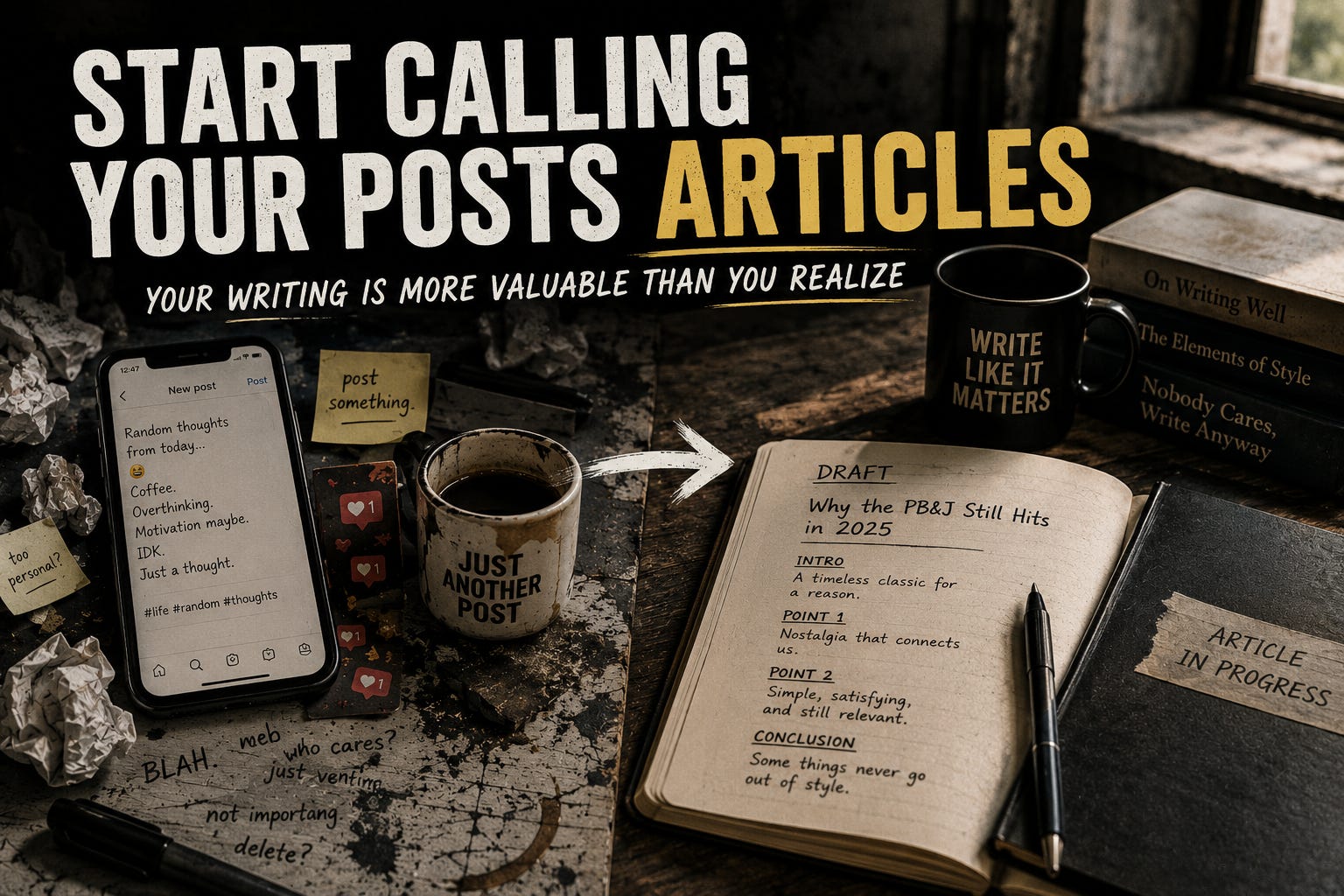
Start Calling Your Posts Articles
Your writing is more valuable than you realize

The following article was first published on June 16th, 2025 on Medium.com
When you pitch your newest piece of writing, what do you call it?
I spent years in the blogging world, and I got used to calling everything I wrote online a “post.” It’s a habit I’m trying to break—and honestly, I think you should too.
Here’s why.
If you jump on social media and say, “New post — read it now,” it sounds casual. Maybe even trivial. It implies you wrote something personal, but not necessarily something professional or worth someone’s time.
A “post” could be about anything:
what you ate for breakfast
what your cat threw up last night
some random late-night thought you typed out half-asleep
There are no real quality expectations attached to the word post.
That’s because the term blog comes from web log. At its core, it carries the tone of a diary entry or journal. So when we call our writing a “post,” we’re subtly telling people:
This is mostly just for me.
Now compare that to the word article.
“New article — just published!” feels different.
Articles belong in magazines, newspapers, journals, and industry publications. The word implies structure, thought, and purpose—even if that’s not always deserved.
But perception matters.
Calling your work an article sets a tone. It signals to your audience—and to yourself—that the writing is intentional, not casual. Crafted, not tossed together. Meant to inform, persuade, entertain, or inspire—not simply vent into the void.
If you keep calling everything a “post,” you may be unintentionally telling people:
This isn’t that serious.
And if it’s not serious, why should anyone take the time to read it?
How to Turn Posts Into Articles (Easily)
Start by taking yourself more seriously.
Then ask a simple question:
Does this serve anyone besides me?
If the answer is no, rewrite it.
Let’s make that practical.
Imagine you wrote a blog post about the incredible peanut butter and jelly sandwich you had for lunch.
Good for you.
Nobody cares.
But now let’s turn that same idea into an article.
Instead of focusing on what you ate, focus on what other people might find useful, relatable, or entertaining.
That same PB&J could become:
A quick, macro-balanced meal for runners (fitness audience)
A kid-approved school lunch hack (parenting audience)
A nostalgic breakdown of why PB&J still slaps in 2025 (culture audience)
A food-allergy awareness piece about peanut butter alternatives (health audience)
Same sandwich.
Different framing.
Different value.
Conclusion — You’re a Writer, Act Like One
If you’re going to write, don’t just slap words on a screen and hit publish.
Stop.
Re-read.
Adjust.
Re-read again.
Adjust again.
Then publish—or maybe revise it one more time.
Finally, share your article with your audience in mind, not just yourself.
Because when you take those extra moments to craft something intentionally, your writing stops being just another “post”…
And starts becoming something—
Uncredible.
Music for voice over by Jeremusic70 on Pixabay.