
How Far is Too Far?
Pushing Your Limits

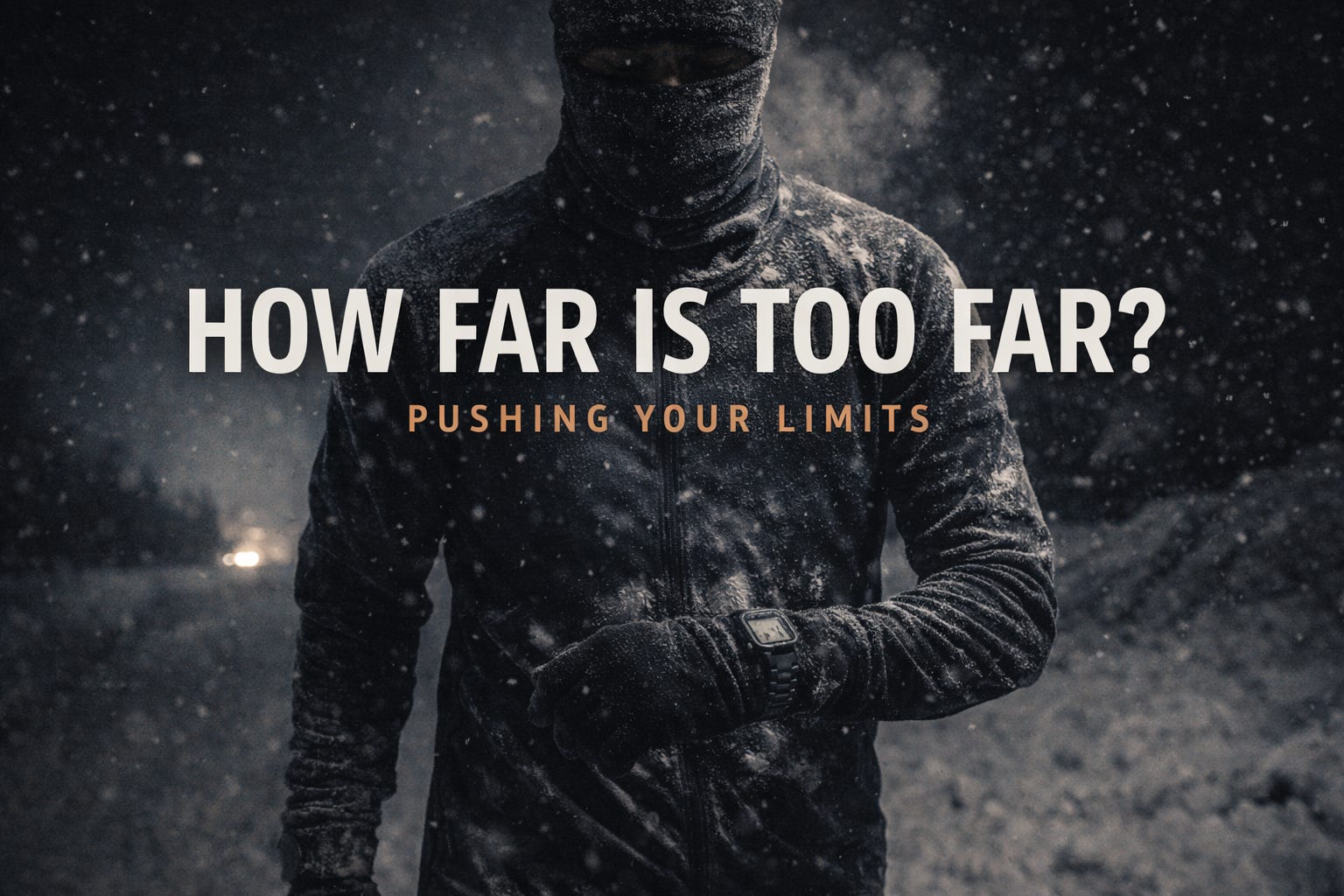
Have you ever wondered, how far is too far?
A couple of weeks ago, I ran my coldest long run ever—eight miles in -4° weather. It was early morning. It was dark. And the farther I ran away from home, the more nervous I became that I might have gone too far.
One simple truth about running outdoors is this: for every step you take away from home, you have to take one more to get back. When you’re a mile out, you only need to cover a mile to return. But as that number grows—and your body starts to fatigue—you begin to question whether you’ve crossed a line.
In a recent episode of the Uncredible Podcast, I talked about how I began to panic just three miles into that run and nearly turned back. I didn’t—but the experience stuck with me and kept circling one question:
How far is too far?
Our Minds Lie
The more I push myself in running—and in fitness in general—the more I realize how hardwired our minds are for survival. We tend to believe we’ve gone too far long before we actually have.
Every now and then, we miscalculate. We fail. And when that happens, our minds store the memory like evidence for the next time we’re tempted to push the limits.
See? I told you so.
The argument feels airtight:
Maybe the last time you tried this, you failed.
Maybe it was dangerous.
Maybe you barely escaped.
Maybe this time you won’t be so lucky.
What if this time you really get hurt?
And here’s the frustrating part: those arguments aren’t irrational. They’re grounded in experience.
Hypothetical—Meet Actual.
When those thoughts creep in, I force myself to slow the moment down—mentally and physically.
First, I ask a simple question:
Have I felt like this before?
If the answer is yes, I keep going.
Next, I look for an objective anchor—something concrete to assess. Often, that’s my heart rate. I ask myself:
Am I experiencing something physically new or truly abnormal?
If yes, I slow down and assess.
If no, I proceed.
For example, I occasionally get lightheaded while running. That might alarm most people, but for me it’s familiar. Growing up, I passed out more often than anyone around me was comfortable with. I was never formally diagnosed, but a doctor once suggested I likely had a predisposition to vasovagal syncope.
He wanted to test it. I declined.
At this point in my life, I know the signs. I know when my body is approaching a limit—and I know how to respond. On a run, that usually means slowing down, regulating my breathing, and sometimes hydrating.
Knowing your body matters. Familiarity changes fear.
You Can Probably Go Further
If long-distance running has taught me anything, it’s this:
When I hit a wall, I can usually go farther than I think.
This winter, I’ve committed to running outdoors in brutal cold. Over time, I’ve proven to myself that I can handle long distances in extreme conditions. But snow and ice have limited my speed, so I decided to experiment.
On a recent long run, I split the effort into two segments:
Seven miles outdoors, grinding through snow and cold to simulate late-race fatigue.
Five miles on the treadmill, pushing speed after fatigue had already set in.
It worked better than I expected.
I hadn’t used the treadmill in a while and hadn’t thought through the math of miles-per-hour versus pace. I remembered that 6 mph used to feel “comfortably fast,” while 7 mph felt brutal.
I started at six and settled in. A few miles later, I checked a conversion chart and realized that six mph is a 10-minute mile—a pace I consider easy outdoors.
But my mind remembered seven as painful.
There’s no way I can do seven at the end of a hard run.
I clicked the treadmill up to seven anyway.
The discomfort came quickly. My thoughts raced:
This is too fast.
You’re exhausted.
You could pull something.
If you fall, you’ll get hurt.
I ignored them.
For the final two miles, I held 7 mph (8:34/mile)—significantly faster than the closing miles of my fastest half marathon.
The lesson was obvious:
I could go faster later in a run—if I was willing to push.
There is a Limit
I talk a lot about pushing through pain, ignoring excuses, and testing limits—but it’s important to say this clearly:
There is a limit.
Every body is different. Our survival instincts exist for a reason. Sometimes they hold us back—but ignored at the wrong moment, in the wrong context, they can do real damage.
The challenge isn’t eliminating those instincts.
It’s learning where the line is without crossing it.
When we find the balance between trusting our bodies and challenging them—between caution and courage—we unlock something powerful.
That balance is where growth happens.
That balance is where things become… Uncredible.
Music for voice over by Jeremusic70 on Pixabay.